Personalized Medical Care & Dedicated International Patient Concierge

Medical Guide
Ultherapy PRIME Lifting in Korea: What to Expect
Ultherapy PRIME lifting at Liyan Clinic in Jeju: how micro-focused ultrasound works, who it suits, the honest results timeline, and how US patients plan it.
Schedule a ConsultationUltherapy PRIME Lifting in Korea: What to Expect
Medically reviewed by Dr. Oh Eunhui, Medical Director, Liyan Clinic
If you have started noticing that your jawline is softer than it used to be, or that the skin under your chin no longer snaps back the way it once did, you have probably run into the same question every patient in that position runs into: is there something between doing nothing and having surgery?
Ultherapy PRIME is one answer to that question. It is a non-surgical treatment that uses focused ultrasound energy to reach selected layers of tissue beneath the skin, creating controlled thermal effects that can stimulate tightening and collagen remodeling over time. It is commonly used for mild-to-moderate skin laxity in the brow, the lower face, the jawline, the under-chin area and the neck, depending on the treatment plan and the applicable device indications.
This guide explains what the treatment actually does, who it suits, and what the timeline honestly looks like. Liyan Clinic in Jeju City offers Ultherapy PRIME as one of its named signature lifting programs, and this article is written for patients traveling from the United States who want the details before they book anything.
How focused ultrasound lifting works
The mechanism is easier to understand if you separate it from what a facelift does. Surgery removes excess skin and repositions tissue. Ultherapy PRIME does neither. It delivers energy into specific depths of tissue, and the tissue's own healing response does the rest.
The energy creates controlled thermal effects at the depths the clinician selects. Those effects are what stimulate collagen remodeling. Because collagen remodeling is a biological process rather than a mechanical one, the change appears gradually — and the degree of change varies from person to person, which is the single most important sentence in this article.
What the "with visualization" part means
The technology behind Ultherapy PRIME is micro-focused ultrasound with visualization, made by Merz Aesthetics in the United States. The visualization part is not marketing language. The system uses ultrasound imaging in real time so the clinician can see tissue layers while treating, and select treatment depths based on what is actually there rather than relying only on external measurements.
Ultrasound imaging itself is a long-established medical technology. The US Food and Drug Administration describes diagnostic ultrasound as a technique that uses sound waves to produce images of structures inside the body, and notes that it does not use ionizing radiation. In an aesthetic context the same physical principle is put to a different use: seeing the layer, then treating the layer.
The practical consequence for you is that treatment can be planned at selected depths rather than applied uniformly. That matters most in areas where the anatomy is thin or where the depth of the tissue you want to affect varies across a small area — the under-chin region, for instance.
What it will not do
Ultherapy PRIME does not remove excess skin. Where the underlying issue is a significant amount of loose skin or advanced tissue descent, an energy-based treatment will under-deliver, and a surgical approach is what the anatomy actually calls for. A treatment that is described honestly is easier to be satisfied with than one that is described generously, so it is worth being direct about this before rather than after.
Who is a candidate, and who is not
Adults with mild-to-moderate skin laxity or reduced firmness who want a non-surgical treatment may be candidates. Beyond that, the requirements are unglamorous: suitable general health, realistic expectations, and an understanding that results are generally gradual rather than immediate.
A doctor should assess facial anatomy, the degree and location of laxity, skin condition and your treatment goals before anything is scheduled.
There are situations in which treatment should be avoided or postponed. These include open wounds or lesions in the treatment area, severe or cystic acne in the treatment area, and active or metallic implants in the treatment area. Ultherapy has also not been evaluated in certain populations, including pregnant or breastfeeding women and children. This is a list to raise at consultation, not one to self-apply.
What a session is actually like
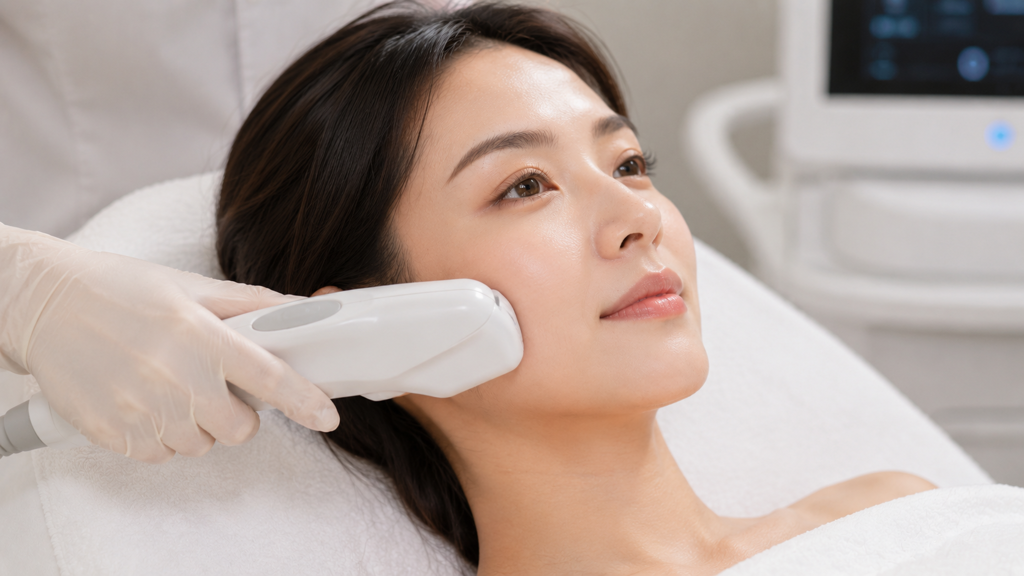
The sequence at Liyan Clinic is straightforward. The treatment area is cleansed and prepared. Treatment areas may be mapped or marked. Comfort measures, such as topical numbing, may be used when appropriate. The applicator is then placed on the selected areas and focused ultrasound energy is delivered according to the plan. The clinician checks the treated area afterwards, and aftercare and follow-up instructions are provided.
Treatment time is roughly 45 to 90 minutes, depending on the shot count the plan calls for. Usually one session is done per treatment cycle, with a review after about three months. No overnight stay is required for a treatment of this type.
Sensation varies between patients. During treatment you may feel heat, tingling or brief discomfort as energy is delivered. How that lands depends on you and on the plan.
One detail worth understanding before you arrive is that the shot count is not a fixed number attached to the treatment name. It is a decision made about your face, and it is the main reason two people can have the same treatment and spend different amounts of time in the chair. When you are comparing what one clinic proposes against what another does, the shot count and the areas covered are the comparison that means something. A plan described only by the name of the device has not told you what you are getting.
Before treatment, a consultation should cover your medical history, medications, previous aesthetic procedures and what you are actually hoping to change. The doctor examines the skin and the underlying facial anatomy and assesses how much laxity there is and where it sits. Only then is it possible to say whether this treatment is the right one, which areas should be treated, and what plan makes sense.
The timeline, week by week
This is where expectations most often go wrong, so here is the sequence as the clinic describes it.
- The day itself. Warmth across the area, and a flush that shows. Cosmetics can go straight back on for a treatment in this class.
- The first three days. Nothing that keeps you indoors; mild tenderness and a little puffiness are usual and pass on their own.
- One week in. You look like yourself again. Underneath, remodeling has started and is showing nothing.
- Four to six weeks. The first point at which most people notice anything at all.
- Two to three months. The peak of the effect sits somewhere between three and six months.
- Six to twelve months. Effect is generally discussed as running 12 to 18 months before a top-up is considered.
Two things follow from that shape. First, if you are treating before an event, the useful lead time is months, not weeks. Second, judging the result at week two is judging it before it exists.
Possible short-term effects include redness, swelling, tenderness, warmth, tingling, sensitivity or discomfort. Less common complications may include bruising, prolonged changes in sensation, burns or other tissue injury. Severe or worsening pain, significant swelling, blistering, marked skin changes or other unexpected symptoms are reasons to seek medical advice rather than wait.
Planning this from the United States
Getting home from Jeju is a long day of flying, and it is worth settling the timing of it in advance. For a non-invasive energy treatment there is no accepted reason to delay a flight, but the clinic confirms its own advice for your case, and that conversation belongs before you book the return leg rather than after.
Because Ultherapy PRIME generally has no required recovery period, a prolonged stay is not normally necessary for the treatment itself. Allow enough time for consultation and treatment, and leave room for your own response to it.
An online consultation is available and can help you discuss general suitability before you travel, though it does not replace an in-person assessment. For a preliminary consultation the clinic commonly asks for clear facial photographs and information about your medical history, medications, previous aesthetic treatments and goals. English-speaking support is available for consultation.
If something unexpected or persistent develops after you are home, contact the clinic promptly rather than waiting for a scheduled follow-up. You can reach the clinic through its contact page.
Choosing where to have it done
The American Academy of Dermatology publishes a list of questions worth asking before any cosmetic treatment, and the underlying idea transfers well to treatment abroad: you are entitled to know who is performing the treatment, what device is being used, and what result is realistic for your anatomy. MedlinePlus, the patient-information service of the US National Library of Medicine, makes a similar point about medical appointments generally — going in with your questions written down changes what you get out of the visit.
Liyan Clinic has treated patients from the same address in Jeju City since 2013, and its own materials make that continuity at one location one of the reasons patients give for trusting it. More than 60,000 patients have been treated there since opening. The medical team is three doctors: Dr. Oh Eunhui, who is Medical Director and the clinic's legal representative, Dr. Hyun Moonsu, Vice Director, and Dr. Kum Seunkon, Vice Director. Dr. Oh Eunhui is a graduate of Seoul National University and a full member of the Korean Society of Aesthetic Plastic Surgery and Laser Medicine and of the Korean Society of Laser Dermatology and Hair Research, among other Korean aesthetic medical societies. Society membership is a fact of record — it says a body admitted a doctor, not how a treatment will turn out.
You can read more about the clinic on its about page, and patient feedback is collected on its reviews page.
The Bottom Line
- Ultherapy PRIME uses micro-focused ultrasound with real-time visualization to treat selected tissue depths; it tightens what is there and does not remove skin.
- It suits adults with mild-to-moderate laxity who want a non-surgical option and can accept gradual change.
- Expect about 45 to 90 minutes of treatment time, no social downtime, first visible change at four to six weeks, and the fullest effect at three to six months.
- The effect is typically discussed as lasting around 12 to 18 months before a top-up is considered.
- Significant loose skin is a surgical problem, not an ultrasound one — a consultation should say so plainly.
Frequently Asked Questions
Who is a good candidate for Ultherapy PRIME?
Adults with mild to moderate skin laxity, loss of firmness or early sagging who want a non-surgical lifting treatment. It particularly suits people looking for gradual, natural-looking improvement without surgery or significant downtime.
Who should avoid or postpone treatment?
People with open wounds or lesions, severe or cystic acne in the treatment area, or active or metallic implants in the treatment area. The treatment has not been evaluated in certain populations, including pregnant or breastfeeding women and children. A doctor should assess your history and the treatment area beforehand.
How long does a session take?
Roughly 45 to 90 minutes of treatment time, depending on the shot count in your plan. One session per treatment cycle is usual, with a review after about three months.
When will I see results, and when is the result final?
Early change becomes noticeable at about four to six weeks. The fullest effect develops at about three to six months.
How many days should I stay in Korea?
There is generally no required recovery period, so a long stay is not normally necessary for the treatment itself. Allow time for consultation and treatment, and confirm your travel timing with the clinic.
Can I have a consultation before I travel?
Yes. Online consultation is available, and the clinic commonly asks for clear facial photographs plus your medical history, medications, previous aesthetic treatments and goals. It informs the plan; it does not replace an in-person assessment.
What should I do if I have a concern after flying home?
Contact the clinic promptly if you develop an unexpected or persistent reaction. Severe or worsening pain, significant swelling, blistering or marked skin changes are reasons to seek medical care where you are, without waiting.
This article is for general informational purposes only and does not constitute individualized medical advice. It is not a self-diagnosis tool, and it cannot replace an in-person assessment by a licensed dermatologist who has examined your skin.
More Articles
Continue reading our clinical guides.
Ultherapy PRIME Lifting in Korea: What to Expect
Ultherapy PRIME lifting at Liyan Clinic in Jeju: how micro-focused ultrasound works, who it suits, the honest results timeline, and how US patients plan it.
Learn More

Potenza RF Microneedling: Texture, Pores, and Scars
Potenza RF microneedling at Liyan Clinic in Jeju: how needles plus radiofrequency treat texture and acne scars, how long a course runs, and what to ask.
Learn More

Thermage FLX RF Skin Tightening: A Patient's Guide
Thermage FLX at Liyan Clinic in Jeju: how monopolar radiofrequency tightening works, what the shot count means, the results timeline, and who it suits.
Learn More