Personalized Medical Care & Dedicated International Patient Concierge

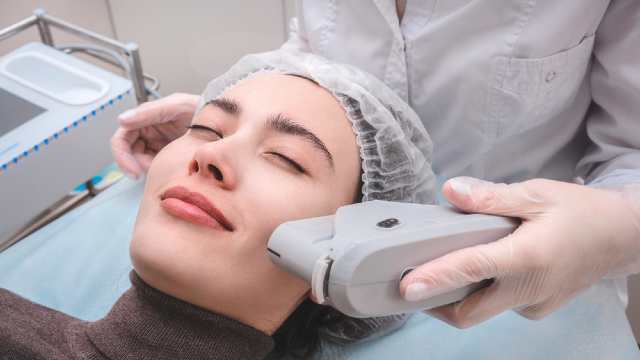
Medical Guide
Ultherapy vs Thermage FLX: Which Lifting Device Fits You?
Ultherapy vs Thermage at Liyan Clinic in Jeju: one aims at a depth it can see, the other heats a field. What each treats, and how to tell them apart.
Schedule a ConsultationUltherapy vs Thermage FLX: Which Lifting Device Fits You?
Medically reviewed by Dr. Oh Eunhui, Medical Director, Liyan Clinic
Ultherapy vs Thermage is the comparison American patients raise most often at Liyan Clinic, and the usual framing — which one is stronger — produces a bad answer. They are not two strengths of one idea. One aims energy at a depth the operator can see on a screen; the other heats a field through the surface. Almost everything else follows from that.
One of them looks before it treats
Start with the capability that is genuinely unique, because it is the cleanest way to tell these two apart.
Ultherapy PRIME uses micro-focused ultrasound with visualization — the manufacturer is Merz Aesthetics in the United States — and the visualization half is not a marketing flourish. Real-time imaging helps the clinician identify tissue layers and guide where the energy goes, so treatment can be planned at selected depths rather than by relying only on external measurements. The energy is focused, meaning it converges at a chosen plane and does comparatively little on the way there.
Thermage FLX works on an unrelated principle. It is a non-invasive monopolar radiofrequency system from Solta Medical that delivers controlled heating to the skin and the tissue beneath it, and depending on the system and accessory it may use vibration during treatment. There is no aiming at a plane. Energy passes through a region and warms it, and the depth profile is a property of the applicator and the settings rather than something chosen per pass against a live picture.
The US Food and Drug Administration's consumer material on ultrasound explains what ultrasound imaging does generally, which is useful background for understanding why "with visualization" is a meaningful phrase rather than a slogan.
Neither approach is superior in the abstract. Aiming matters when the target is a specific layer. Field heating matters when the concern is spread across an area and no single plane is the answer.
What each is documented to treat
This is where the choice usually resolves itself, and it resolves faster than people expect.
Ultherapy PRIME addresses the appearance of mild-to-moderate laxity, and the regions it is used for run from the brow down: lower face, jawline, beneath the chin, and the neck — subject to the plan agreed for you and to what the device is indicated for. Read that list: it is a list of places where tissue has descended.
Thermage FLX is used for facial and periorbital areas, with its manufacturer identifying non-invasive treatment of wrinkles and rhytids — including periorbital wrinkles and the upper and lower eyelids — among its indications. The clinic describes it as addressing overall skin laxity, fine crepey texture and jawline definition, all without surgery and without an incision.
So the two lists overlap at the jawline and separate almost everywhere else. A concern in the fine, crepey skin around the eyes has an obvious home. A brow that sits lower than it did, or a neck that has lost its line, has a different one. If your own concern sits in the overlap, that is not a failure of the comparison — it means you have a real choice, and the rest of this article is about how to make it.
Both come with the same honest limitation, stated in the clinic's own terms: neither removes excess skin, and neither should be presented as producing what surgery produces. Where the anatomy needs skin removed, an energy device will under-deliver no matter which energy it uses. The American Academy of Dermatology's guide to firming sagging skin covers the same boundary for a reader in the United States, and it is worth reading before you form an expectation rather than after.
The numbers, side by side
Both have documented timelines, which is more than everything on this menu can say for itself. Here they are once, without embroidery.
| Ultherapy PRIME | Thermage FLX | |
|---|---|---|
| Energy | Micro-focused ultrasound with visualization | Monopolar radiofrequency |
| Early change | From about 4–6 weeks | Some immediate tightening, then progressive |
| Fullest effect | At about 3–6 months | At about 2–6 months |
| Duration | Around 12–18 months before a top-up is considered | Commonly described as up to about 12–24 months |
| Cycle | Usually one session per cycle, reviewed after 3 months | Typically one session, repeated at 12–18 month intervals |
| Chair time | 45–90 minutes | 60–90 minutes for a full-face treatment |
Two things in that table are worth a second look.
The radiofrequency option is the only one of the two that gives you anything on the day — some immediate tightening, before the slower change begins. For a patient who has flown a long way and would like evidence that something happened, that is a real difference, and it is honest to say so as long as nobody mistakes the day-one effect for the result.
And the durations are closer than the marketing of either would suggest. Both sit in the region of a year to two years before the question comes round again. Choosing between them on longevity is choosing on a difference that may not be there.
What the appointment costs you in time
Neither treatment takes a day out of your life, but they do not cost the same hour.
Thermage FLX is described with no downtime, with transient redness and warmth for a few hours being usual, and a chair time of 60 to 90 minutes for a full-face treatment — an appointment that fits inside a single day of a trip without reorganizing it.
Ultherapy PRIME runs 45 to 90 minutes depending on how much treatment is delivered, and many patients have little or no significant social downtime.
The practical implication for someone on a short stay is not which is faster; it is that both are single-afternoon commitments with no recovery to schedule around. That is unusual, and it is the main reason treatments of this kind suit a trip at all. What does need scheduling is the review — three months for one, and a judgment call for the other — and by then you will be home.
Ask before you leave how the review happens at that distance, what the clinic would want to see, and in what form. It is a two-minute conversation at the end of an appointment and it is the one that most often does not happen.
What neither of them is
Before the tie-breakers, one boundary is worth stating flatly, because it is the single most common source of disappointment in this category.
An energy-based treatment redistributes and tightens the tissue you already have. Where the underlying issue is volume loss, it will not add volume; where the issue is excess skin, it will not remove skin. The clinic states that limitation for the radiofrequency option in plain terms — this treatment does not remove skin, does not replace surgery where surgery is what the anatomy requires, and produces a degree of change that varies between individuals — and the same holds for the ultrasound option, which is described as improving the appearance of mild-to-moderate laxity rather than as an equivalent to a facelift.
That matters most for readers who have already decided that surgery is out of the question. A device does not become the right answer because the right answer was rejected. If the assessment says the change available to you is modest, the useful response is to decide whether a modest change is worth the appointment — not to look for a stronger machine.
When both still look right
Sometimes the honest answer after all of the above is that either could suit you. That is a good position to be in, and there is a way to use it.
Ask the clinician to say which they would choose for your face and why — and listen for whether the reason is about your anatomy or about the device. "Your concern is laxity along the jaw and under the chin, and I want to place energy at a specific depth there" is a reason. "It is our best machine" is not a reason; it is a preference with a sentence wrapped around it.
Ask what they would expect to change and what they would expect not to change. A clinician who names something the treatment will not fix is giving you the most valuable information in the appointment.
Ask what the plan would be if the result at the review is less than hoped. Both devices sit in a range of outcomes rather than delivering a single one, and knowing in advance whether the answer is "wait longer", "repeat", or "this was the wrong tool" saves a bad conversation later.
The American Academy of Dermatology publishes a list of questions worth asking before any cosmetic treatment, and it is a better script than anything you will improvise in the room. MedlinePlus, the US National Library of Medicine's patient service, sets out how to think about choosing a provider in the first place — worth reading with extra care when you are choosing at a distance and cannot rely on the usual local signals.
Both devices are also described by their makers in regulatory terms that are specific to particular markets and particular indications, and general consumer material from the US Food and Drug Administration on aesthetic devices is a reasonable way to calibrate what such statements do and do not mean before you read any clinic's version of them.
One last practical note. Because both treatments are single sessions reviewed months later, the decision you are making is unusually consequential for the amount of time it takes. There is no second session to correct course in, the way there is with a multi-session course. So take the consultation seriously, bring the questions in writing, and do not decide in the chair. Send them ahead through the contact page; the about page describes the practice that will be answering them.
The Bottom Line
- Ultherapy PRIME uses micro-focused ultrasound with visualization, so energy can be aimed at a depth the clinician can see; Thermage FLX is monopolar radiofrequency that heats a region rather than aiming at a plane.
- Their documented uses separate cleanly: descent along the brow, jawline, under-chin and neck for one; wrinkles, fine crepey texture and periorbital areas for the other.
- The timelines are close. Both peak within months and both are commonly discussed in the region of one to two years, so longevity is a weak basis for choosing.
- Only the radiofrequency option is described as giving any immediate change, which matters to a patient who wants to see something before flying home.
- Neither removes excess skin or replaces surgery — if that is what the anatomy needs, both will under-deliver.
Frequently Asked Questions
What is the actual difference between them?
One is focused ultrasound delivered with real-time visualization, so it can be planned at selected depths; the other is monopolar radiofrequency that heats tissue across a region. Aiming versus field heating is the whole distinction.
Which one is better for the area around my eyes?
Thermage FLX is used for facial and periorbital areas, and its manufacturer names periorbital wrinkles and the upper and lower eyelids among its indications. Bring the specific concern to consultation rather than deciding from a list.
Which one is better for my jawline?
Both are described as addressing the jawline, which makes it the one area where the choice is genuinely open. Ask the clinician to explain their pick in terms of your anatomy.
How long does each last?
Ultherapy PRIME is typically discussed as lasting around 12 to 18 months before a top-up is considered. Thermage FLX is commonly described as lasting up to about 12 to 24 months.
When will I see something?
Ultherapy PRIME shows early change from about four to six weeks and is fullest at about three to six months. Thermage FLX shows some immediate tightening and then progresses, reaching its fullest effect at about two to six months.
How long is the appointment, and is there downtime?
Ultherapy PRIME runs 45 to 90 minutes, with little or no significant social downtime for many patients. Thermage FLX is 60 to 90 minutes for a full-face treatment, with no downtime and transient redness and warmth for a few hours.
Can I have both?
Whether two energy treatments belong in one plan, and in what order, is a clinical decision rather than a matter of preference. Ask for the reasoning behind any combination proposed to you.
What if neither is right for me?
Then that is the useful outcome of the consultation. Neither removes excess skin, and where significant laxity or tissue descent is present, a different category of treatment may be the honest answer.
This article is for general informational purposes only and does not constitute individualized medical advice. It is not a self-diagnosis tool, and it cannot replace an in-person assessment by a licensed dermatologist who has examined your skin.
More Articles
Continue reading our clinical guides.
Ultherapy PRIME Lifting in Korea: What to Expect
Ultherapy PRIME lifting at Liyan Clinic in Jeju: how micro-focused ultrasound works, who it suits, the honest results timeline, and how US patients plan it.
Learn More

Potenza RF Microneedling: Texture, Pores, and Scars
Potenza RF microneedling at Liyan Clinic in Jeju: how needles plus radiofrequency treat texture and acne scars, how long a course runs, and what to ask.
Learn More

Thermage FLX RF Skin Tightening: A Patient's Guide
Thermage FLX at Liyan Clinic in Jeju: how monopolar radiofrequency tightening works, what the shot count means, the results timeline, and who it suits.
Learn More