Personalized Medical Care & Dedicated International Patient Concierge

Medical Guide
Thermage FLX vs Shurink: Which Non-Surgical Lift Suits You?
Thermage vs Shurink at Liyan Clinic in Jeju: one comes with published numbers and one is set at consultation. What that means for planning a trip.
Schedule a ConsultationThermage FLX vs Shurink: Which Non-Surgical Lift Suits You?
Medically reviewed by Dr. Oh Eunhui, Medical Director, Liyan Clinic
Most guides to Thermage vs Shurink stop at the mechanism — radiofrequency against focused ultrasound — and that is the least useful half of the comparison for anyone who has to buy a plane ticket. The difference that actually changes your decision is this: one of these treatments comes with published numbers you can plan a trip around, and the other is set at the consultation. Knowing which is which, and why, is worth more than another paragraph about energy.
The mechanisms, briefly
Both are non-surgical, both aim at the appearance of skin laxity, and neither involves an incision.
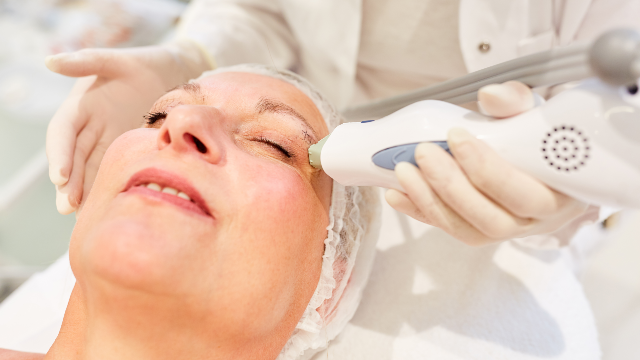
Thermage FLX is a non-invasive monopolar radiofrequency treatment from Solta Medical. It delivers controlled radiofrequency heating to the skin and the tissue beneath it and, depending on the system and accessory, may use vibration during treatment. Among the indications named by its manufacturer is non-invasive treatment of wrinkles and rhytids — periorbital wrinkles included, and the upper and lower eyelids as well. The clinic uses it for facial and periorbital areas.
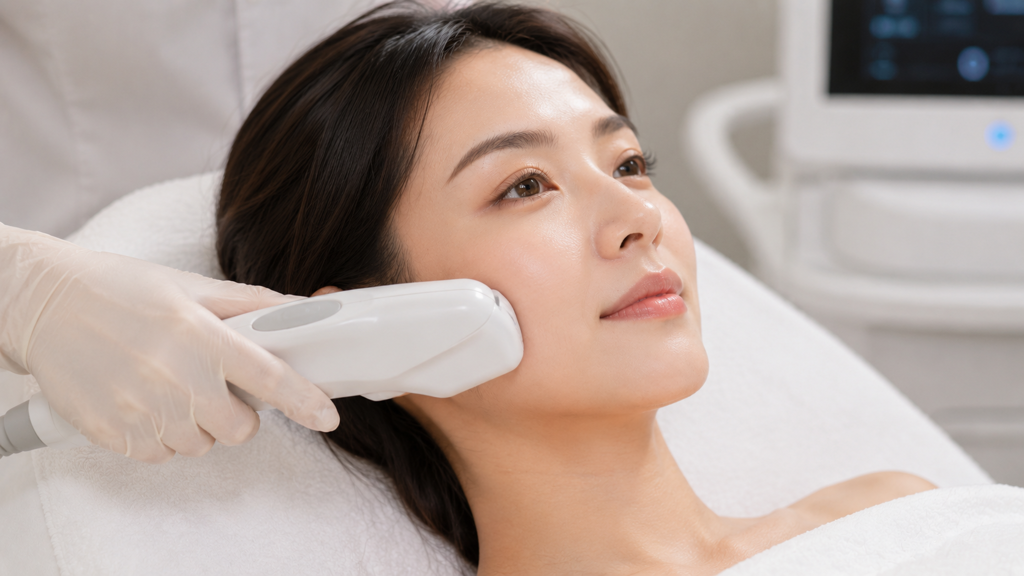
Shurink Lifting is high-intensity focused ultrasound. Energy is placed into selected layers of tissue, where the controlled thermal effect it produces can support tightening and collagen remodeling. Typical regions are the cheeks, the jawline and the area beneath the chin, according to what the plan calls for.
That is genuinely all the mechanism you need in order to choose, and the American Academy of Dermatology's guide to firming sagging skin covers the category's realistic ceiling for a reader in the United States. Both share the same honest limit: neither removes excess skin, and neither provides what a facelift provides.
One of them comes with numbers
Now the part that matters.
| Thermage FLX | Shurink | |
|---|---|---|
| Onset | Some immediate tightening, then progressive | Gradual, over several weeks to months |
| Fullest effect | About 2–6 months | Not stated as a fixed period |
| Duration | Commonly described as up to about 12–24 months | Varies by area, skin condition and individual response |
| Sessions | Typically one, repeated at 12–18 month intervals | Individualized |
| Chair time | 60–90 minutes for a full-face treatment | Varies by area, device and protocol |
| Downtime | None; transient redness and warmth for a few hours | Temporary warmth, tenderness or swelling may follow |
Read the right-hand column carefully, because the temptation is to read it as a gap in the information and it is not one.
Every empty-looking cell there is a number the clinic will not publish because it would then have to qualify it. For the ultrasound treatment the number of sessions is individualized, treatment time varies with the area, the device and the protocol, and — in a line that is unusually direct — international patients are told to confirm the recommended length of stay before booking their return flight. That is not vagueness. That is a treatment whose plan is genuinely made at the assessment, told to you in advance so you do not build an itinerary on a guess.
The left-hand column is the opposite proposition. Those numbers are published because they hold across most patients, which is what lets you put the appointment in a calendar before anyone has looked at your face.
What each column costs you
The asymmetry has a practical price on both sides, and it is worth being explicit.
Planning with published numbers. You can book a return flight, schedule the appointment inside a single day, and know roughly when to expect change and when the question comes round again. The cost is that a published range is a range — "up to about 12 to 24 months" is a long span, and where you land inside it is not knowable in advance. A number you can plan around is not a number you are promised.
Planning with an individualized answer. You get a plan built for your face, and if the honest recommendation is more than one session, you find that out rather than discovering it later. The cost is that you cannot finalize a travel schedule until that conversation has happened — and if you have already booked a return flight, the recommendation and the ticket may disagree.
This is why the ultrasound option raises the return flight at all. The sequence it implies is: ask first, book second. For a patient who has done it the other way round, the fix is to say so at the start of the consultation, so the plan you are offered is one you can actually complete.
Getting the individualized answer before you commit
There is a straightforward way to get most of the certainty back, and almost nobody uses it.
Write to the clinic before booking anything and describe your concern, your available dates and your constraints. Ask what they would need to know in order to say how many sessions and how much time. Ask what the likely range is for someone with your described concern, and what would push it to the upper end.
What a remote consultation is and is not good for is set out by MedlinePlus, the patient service of the US National Library of Medicine, and the line it draws lands squarely on this case. At a distance, history can be gone over, questions can be answered and preparation can be explained. Finalizing the plan takes an assessment. What it can do — and this is the useful part — is turn an unknown into a range before you buy a ticket.
For a starting script, the American Academy of Dermatology publishes questions worth putting before any cosmetic treatment. Add two of your own for this particular pair: how many sessions would you expect, and what would change that answer.
What the appointment is like
Neither of these takes a day out of a trip, but they are not the same afternoon.
The radiofrequency treatment is 60 to 90 minutes for a full-face session, with no downtime and transient redness and warmth for a few hours afterwards being usual. You can treat it as one item in a day rather than as the day.
The ultrasound treatment's session length depends on the area, the device and the protocol, so it is the one to ask about specifically when you are building a schedule. Temporary warmth, tenderness or swelling may follow, and it is generally an outpatient procedure with no overnight stay.
Both develop over weeks to months, which means the appointment is the short part and the waiting is the long part. Neither is a treatment you assess on the way to the airport.
When the published number and your result disagree
There is a scenario worth thinking through before it happens, because it is the one people handle worst.
You have the treatment with the published timeline. Three months pass. The change is less than you expected, or you cannot tell whether there has been one. What now?
The first thing to know is that a published range is a description of what is usually seen, not a commitment about you. "Up to about 12 to 24 months" and "fullest effect at about two to six months" are both ranges, and a result that lands at the modest end of a range is an ordinary outcome rather than a failure of the treatment or of the clinic.
The second thing is that this category produces change that is gradual and varies in degree between individuals, which makes it genuinely hard to judge from memory. If you want a real answer at the review, you need something to compare against — a set of photographs taken before the appointment, in daylight, from the same angles, which takes five minutes and almost nobody does.
The third is that the useful question at the review is not "did it work" but "given what you see, what would you do next" — repeat, wait longer, or change approach. Agreeing in advance that you will ask that question, and when, converts a vague disappointment into a decision. Settle the date and the method before you leave the clinic, because from another country neither is easy to arrange after the fact.
Choosing between a number you have and a number you do not
If you want one rule, here it is: choose the published-number option when your constraint is the calendar, and the individualized option when your constraint is the face.
That sounds glib, so here is the longer version. If your dates are fixed, your trip is short, and your concern is the kind that a single session is likely to address, a treatment with a published session count and a published chair time removes most of the planning risk. If your concern is less clear-cut, or you suspect the honest answer involves more than one visit, then a treatment whose plan is set at assessment is not a disadvantage — it is the one that will tell you the truth earliest.
What you should not do is treat the absence of published figures as the absence of information, or treat the presence of them as a guarantee. Consumer guidance from the US Food and Drug Administration on how to read what a device is authorized for is a good corrective in both directions: published specifications describe what a technology is cleared to do, not what it will do for you.
Ask both questions in writing before you commit — how many sessions for my concern, and what time should I allow — through the contact page. The about page covers the practice that will be answering.
And if the answers come back thinner than you hoped, that is information too. A clinic that tells you a plan cannot be finalized without an assessment is describing how the treatment actually works. One that gives you a confident session count by email, sight unseen, is describing something else.
The Bottom Line
- Thermage FLX is monopolar radiofrequency; Shurink is high-intensity focused ultrasound. Both are non-surgical, and neither removes excess skin or replaces surgery.
- The radiofrequency option publishes onset, peak, duration, session interval and chair time. The ultrasound option routes all of those to the assessment.
- That is a real difference in planning risk, not a difference in quality — and international patients are told, for the ultrasound treatment, to confirm the recommended length of stay before booking a return flight.
- Get the individualized answer as a range before you buy a ticket: describe the concern, ask how many sessions and how much time, and ask what would change the answer.
- Choose on your binding constraint — the calendar points one way, an unclear concern points the other.
Frequently Asked Questions
What is the difference between them?
One is monopolar radiofrequency delivering controlled heating to skin and underlying tissue; the other is high-intensity focused ultrasound delivering energy to selected tissue layers. Both aim at the appearance of laxity without surgery.
Which one has published timelines?
Thermage FLX. Its early change, fullest effect at about two to six months, duration of up to about 12 to 24 months, session interval and 60-to-90-minute full-face chair time are all published.
Why does Shurink not have the same figures?
Because its plan is individualized: the number of sessions, the treatment time and the duration of improvement all vary with the area, the device, the protocol and the individual response.
How many sessions will I need?
For the radiofrequency option, typically one, repeated at 12-to-18-month intervals. For the ultrasound option, the number should be individualized, which is a question to put to the clinic before you fix travel dates.
Is there downtime with either?
Thermage FLX is described with no downtime, and transient redness and warmth for a few hours is usual. After Shurink, temporary warmth, tenderness or swelling may occur. Both are outpatient treatments.
Can I decide before I arrive?
You can get a range before you arrive, which is most of what you need for planning. The final plan is set at the assessment, and a remote conversation cannot substitute for that.
Which is better for my jawline?
Both are described as addressing the jawline area, so the jawline alone will not settle it. Bring the specific concern and your available dates, and let the recommendation follow from both.
Will either of these replace a facelift?
No. Neither removes excess skin, and where significant laxity or tissue descent is present, surgical treatment may need to be considered for a greater degree of correction.
This article is for general informational purposes only and does not constitute individualized medical advice. It is not a self-diagnosis tool, and it cannot replace an in-person assessment by a licensed dermatologist who has examined your skin.
More Articles
Continue reading our clinical guides.
Ultherapy PRIME Lifting in Korea: What to Expect
Ultherapy PRIME lifting at Liyan Clinic in Jeju: how micro-focused ultrasound works, who it suits, the honest results timeline, and how US patients plan it.
Learn More

Potenza RF Microneedling: Texture, Pores, and Scars
Potenza RF microneedling at Liyan Clinic in Jeju: how needles plus radiofrequency treat texture and acne scars, how long a course runs, and what to ask.
Learn More

Thermage FLX RF Skin Tightening: A Patient's Guide
Thermage FLX at Liyan Clinic in Jeju: how monopolar radiofrequency tightening works, what the shot count means, the results timeline, and who it suits.
Learn More