Personalized Medical Care & Dedicated International Patient Concierge

Medical Guide
Sculptra for Volume Restoration: Timeline and Longevity
Sculptra at Liyan Clinic in Jeju: how PLLA rebuilds volume through your own collagen, the six-month peak, the two-year horizon, and why you need a photo record.
Schedule a ConsultationSculptra for Volume Restoration: Timeline and Longevity
Medically reviewed by Dr. Oh Eunhui, Medical Director, Liyan Clinic
Sculptra asks more patience than anything else Liyan Clinic offers, and it repays it with the longest horizon. Understanding both halves of that trade before you book is what separates patients who are pleased with it from patients who quietly conclude nothing happened.
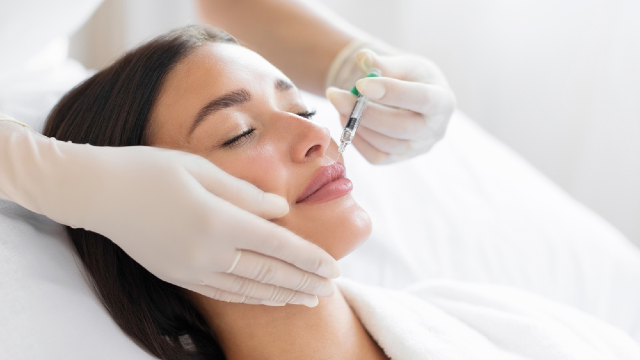
It is an injectable poly-L-lactic acid collagen stimulator — PLLA — dosed per vial. Microparticles are injected into the deep dermis and subcutis, where they are gradually resorbed while your body deposits its own collagen in their place. The result appears over months rather than immediately.
Deep, and therefore slow
The depth is the reason for everything else.
This is the clinic's deepest-acting collagen stimulator, and it is used for the mid-face, the temples and other volume-deficient areas. Those are structural regions — places where loss shows as a change in shape rather than in surface quality — and rebuilding structure through your own tissue is a slower process than conditioning skin.
PLLA stimulates collagen production gradually, which helps with facial volume loss, wrinkles and skin structure. Note the verb: stimulates. Nothing you are given is the result. What you are given prompts a response, is resorbed, and leaves the response behind.
That has an odd and useful consequence. There is no point at which the material is "in there" in the way patients imagine with a conventional filler, and so there is no moment when it can look overdone on the day. Whatever appears, appears because your tissue made it.
Who it suits
Adults with age-related facial volume loss, reduced skin firmness, fine lines or wrinkles who prefer gradual improvement and are medically suitable for injectable treatment.
It is not suitable for people with known hypersensitivity to the product or its components, active skin infection or inflammation at the treatment site, or certain medical conditions requiring individual assessment.
What it offers is gradual improvement in facial volume and structural support, a softer appearance of wrinkles, and a more rejuvenated look overall — developing progressively rather than arriving.
One reason American patients raise it specifically is worth naming: Sculptra is available in the United States, so unlike several treatments on this clinic's menu it is not unfamiliar. Patients who already know the product from their own market can judge an amount without first learning a new brand, which is a genuine advantage when you are making a decision abroad.
The timeline, stated as numbers
Chair time is 30 to 45 minutes. A series of sessions spaced several weeks apart is standard for this product, which means the commitment you are agreeing to is measured in months before it is measured in appointments. That is worth registering at the point of booking rather than at the point of the second session.
Then the schedule that matters:
| When | What is happening |
|---|---|
| First days | Injection-site effects — redness, swelling, bruising, tenderness, discomfort |
| Weeks 1-5 | Nothing visible. The response has started and has not surfaced |
| From 6-8 weeks | Early change becomes noticeable |
| About 6 months | The fullest effect |
| Around 2 years | The duration this product is widely discussed as reaching |
Six months to peak and roughly two years of duration is the longest arc in this clinic's injectable range, and it is the reason the treatment exists. It is also why the first two months test people.
Common injection-related effects include redness, swelling, bruising, tenderness and pain or discomfort. More persistent lumps or nodules and other complications can occur, which is why appropriate injection technique and medical assessment carry real weight with this product — more than with something whose effect is over in months.
The U.S. Food and Drug Administration maintains a list of approved soft tissue fillers and a consumer page on the category; both are worth reading not because they settle anything about this treatment but because they show what documented, regulated information about an injectable product looks like, which is a useful calibration when you are reading anything else.
Where it sits among the clinic's stimulators
Liyan Clinic carries three collagen stimulators, and they are not redundant. Sculptra is the deepest-acting of them, which is precisely why it is the one used for structural loss rather than for surface quality.
The clinic's nearest alternatives to it are Juvelook, Gouri, Radiesse and conventional dermal filler treatment. Read that list as a spectrum of depth and speed rather than as four competing products. Sculptra sits at one end: deepest, slowest, longest. The others sit progressively nearer the surface, arrive sooner, and last less long.
Which end you belong at is a question about your face rather than about the products. If what has changed is the shape of your mid-face or the fullness of your temples, the deep end is where the answer is, and the wait is the price of it. If what has changed is texture and fine lines, the deep end is the wrong place to spend and a shallower option will show you something months earlier.
A patient who has both — and after fifty most people do — is looking at a sequence rather than a choice, and the order is a clinical judgment. It is worth asking for that judgment explicitly rather than assembling a plan from the menu yourself, because sequencing errors in this category are expensive in time rather than in anything visible: you find out you did them in the wrong order six months later.
One more consideration specific to a stimulator. Because the result is collagen your own body makes, what it can produce depends on the tissue it is asked to work with. That is worth raising directly at consultation — not as an obstacle, but as the question that makes the expectation realistic rather than generic.
Why you need a photo record, and nobody makes one
Here is the practical failure mode of long-arc treatments, and it has nothing to do with whether they work.
Change that takes six months is invisible to the person it happens to. You see your face daily; the comparison your brain makes is against yesterday, and yesterday was almost identical. Six months of almost-identical days adds up to a change you genuinely cannot perceive from the inside — which is why patients who did well sometimes conclude they did not, and why patients who did nothing sometimes conclude they did.
The remedy takes five minutes and almost nobody sets it up.
On the day of your first session, before anything is done, take photographs: straight on, three-quarter left, three-quarter right, in daylight, no makeup, neutral expression. Note the light and the position. Repeat exactly that at six to eight weeks, at three months and at six months.
Then judge the result by comparing the first photograph to the last one — not by how you feel about the mirror. That is the only method that works on this timescale, and it is also what lets you have a useful conversation about whether to repeat the treatment, rather than a conversation about impressions.
The American Academy of Dermatology's guidance on preparing for filler treatment is a good companion here, and its filler overview covers what to expect from the appointment itself. MedlinePlus, the National Library of Medicine's patient service, recommends taking written questions into a medical appointment — and for a treatment assessed over months, the question to write down is simply: when do we review this, and against what?
Planning around two years
A two-year horizon changes the questions worth asking, and they are not the usual ones.
Ask how many sessions the series is expected to run, and how they would be spaced given that you do not live here. Ask what the review point is and whether it can be done remotely. Ask what happens if you cannot return for the second or third session — whether a partial series produces a partial result or something less predictable. And ask what the maintenance pattern looks like two years out, because that is when the decision recurs and you will want to have heard the answer before you are making it from another continent.
The nearest alternatives at this clinic are Juvelook, Gouri, Radiesse and conventional dermal filler treatment. If the two-year arc does not fit your life, one of those probably fits it better, and that is a reasonable thing to establish before you start rather than after.
There is a version of this decision that gets made badly, and it is worth naming. A patient reads that this product lasts longest, concludes that longest is best, and books it without weighing whether they can complete the series or wait out the onset. Duration is a feature, not a ranking. A shorter-acting treatment you can actually follow through is worth more than a two-year arc you abandon after one session, and a clinic that helps you see that is doing its job rather than losing a sale.
Put the review-and-return questions in writing early. They go to the contact page; the about page covers the practice, and the reviews page collects what patients report.
A final word on expectation. The treatments that disappoint people in this category are rarely the ones that failed; they are the ones that were judged on the wrong date, against no record, by someone who had been told a number and had stopped counting. Set the review, take the photographs, and let the treatment have the months it was designed to need. That is most of what separates a patient who is pleased at six months from one who quietly gave up at eight weeks.
The Bottom Line
- Sculptra is a PLLA collagen stimulator placed in the deep dermis and subcutis; the particles resorb and your own collagen is what remains.
- It is the clinic's deepest-acting stimulator, used for the mid-face, temples and other volume-deficient areas.
- Chair time is 30 to 45 minutes, and a series of sessions spaced several weeks apart is standard.
- Early change comes at six to eight weeks, the fullest effect at about six months, and the duration is widely discussed as around two years.
- Set up a photo record on day one — a change this gradual cannot be judged from a mirror, and the comparison is the only honest assessment available to you.
Frequently Asked Questions
How does Sculptra actually work?
Poly-L-lactic acid microparticles are injected into the deep dermis and subcutis. They are gradually resorbed while your body deposits its own collagen in their place, so the result develops over months.
Which areas is it used for?
The mid-face, the temples and other volume-deficient areas — regions where loss shows as a change in shape rather than in surface quality.
How long until I see anything?
Early change comes from about six to eight weeks. The fullest effect arrives at about six months.
How long does it last?
It is widely discussed as lasting around two years, which is the longest arc among this clinic's injectables.
How many sessions will I need?
A series spaced several weeks apart is standard. Your own number is set at consultation, and if you are traveling it is worth asking what a partial series would produce.
What are the risks?
Common injection-related effects are redness, swelling, bruising, tenderness and discomfort. More persistent lumps or nodules and other complications can occur, which is why injection technique and medical assessment matter especially with this product.
How will I know whether it worked?
Photographs. Take a standard set before the first session and repeat them at six to eight weeks, three months and six months, in the same light and position, then compare the first to the last. A change this gradual is not perceptible from the inside.
This article is for general informational purposes only and does not constitute individualized medical advice. It is not a self-diagnosis tool, and it cannot replace an in-person assessment by a licensed dermatologist who has examined your skin.
More Articles
Continue reading our clinical guides.
Ultherapy PRIME Lifting in Korea: What to Expect
Ultherapy PRIME lifting at Liyan Clinic in Jeju: how micro-focused ultrasound works, who it suits, the honest results timeline, and how US patients plan it.
Learn More

Potenza RF Microneedling: Texture, Pores, and Scars
Potenza RF microneedling at Liyan Clinic in Jeju: how needles plus radiofrequency treat texture and acne scars, how long a course runs, and what to ask.
Learn More

Thermage FLX RF Skin Tightening: A Patient's Guide
Thermage FLX at Liyan Clinic in Jeju: how monopolar radiofrequency tightening works, what the shot count means, the results timeline, and who it suits.
Learn More