Personalized Medical Care & Dedicated International Patient Concierge

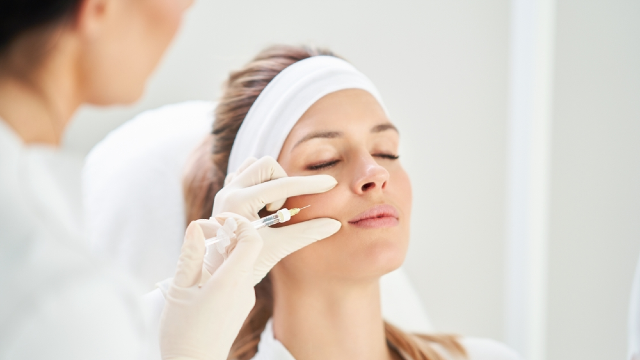
Medical Guide
Rejuran vs Exosome: Comparing Regenerative Injectables
Rejuran vs exosome at Liyan Clinic in Jeju: one is a fixed course, the other varies by delivery route. What the uneven descriptions tell you, and why.
Schedule a ConsultationRejuran vs Exosome: Comparing Regenerative Injectables
Medically reviewed by Dr. Oh Eunhui, Medical Director, Liyan Clinic
Put Rejuran vs exosome side by side and the first thing you notice is not a difference in what they do. It is a difference in how precisely each can be described. One comes with a session count, an interval and a chair time. The other comes with a delivery route that varies, a session count that depends on the plan, and a wider spread of possible outcomes. That unevenness is not a flaw in this comparison — it is the comparison.
Both sit in Liyan Clinic's skin-booster group, both target skin quality rather than shape, and both are things American patients ask about after reading that they are hard to get at home.
What each is aimed at
Rejuran is an injectable skin-rejuvenation treatment for overall skin quality, commonly used for fine lines, uneven texture, dryness and reduced elasticity. Candidates are adults with those concerns, or with an overall decline in skin quality, with suitability decided at consultation.
Exosome treatments use exosome or extracellular-vesicle-based formulations intended to support skin repair and improve skin-quality measures such as hydration, elasticity, texture, pigmentation and fine lines. It suits adults whose concerns are early aging in the skin, a dull or uneven surface, dehydration, fine lines, elasticity that has slipped, or certain pigmentation problems. The proviso is that a clinician has judged both the particular formulation and the route of delivery to be right for them.
Those target lists are close enough that a reader could reasonably take either. One item on the second list is not on the first: pigmentation. If pigment is part of what is bothering you, say so, because it may point the conversation in a direction neither of these is the first answer to.
One is a course; the other is a variable
Here is the asymmetry in its most concrete form.
Rejuran has a documented shape. Chair time is 20 to 40 minutes including numbing, and a course of three to four sessions two to four weeks apart is standard for the product. Improvements are gradual rather than immediate and may require a course to be completed.
An exosome treatment is not one procedure at all. The route into skin is a variable: it may be applied topically, carried in through microneedling or a laser-assisted step, or injected — and which of those applies depends on the formulation and on the protocol being followed. Allow roughly 30 to 60 minutes for a session, more or less according to how large an area is treated and which technique is used; how many sessions you are offered follows from your own goals and from the protocol the clinic works to. A change in how the skin looks is noticed by some people once the treatment is done, and more of it develops across the weeks that follow.
Read those two paragraphs again and notice what is actually different. It is not that one is better documented by accident. It is that one of them has a fixed route into skin and the other has three, and a treatment with three routes cannot honestly be given one recovery profile, one session count or one expected result.
Why the thinner description is the honest one
The temptation, reading a comparison like this, is to treat the better-specified option as the better-understood one and stop there. That is half right and worth unpacking.
A fixed protocol is easier to plan around and easier to compare between clinics. If your priority is knowing what you are committing to, that is a genuine advantage and you should weigh it as one.
But the wider description is not hand-waving. "Delivery may be topical, by microneedling, or by injection" is a real statement about a real variable, and a clinic that collapsed it into a single confident protocol would be telling you less, not more. The same goes for the session count: a number that depends on the product and the plan is a number that should be given after the plan exists.
What this does mean is that the question "what is an exosome treatment like" has no answer until two things are settled — which formulation, and by which route. Until those are named, you are not comparing treatments; you are comparing categories. So make naming them the first item of the consultation rather than a detail at the end.
The Academy of Dermatology's discussion of platelet-rich plasma is a useful companion here for a reason that has nothing to do with the products themselves: it walks through an aesthetic treatment built on a plausible biological mechanism and is candid about where things stand, which is the right register for reading anything in this family. Consumer guidance on regenerative medicine therapies from the US Food and Drug Administration models the questions to ask about a product category whose description is still filling in.
What that means when you have to choose
Three practical readings follow, and they point in different directions for different people.
If you want a plan you can hold before you travel, the fixed-course option is the one that gives you one. Three to four sessions, two to four weeks apart, at 20 to 40 minutes each, is a schedule you can test against a calendar before you buy anything — and testing it is worth doing, because it does not fit a single short trip.
If you want something that can be added to what you are already having, the flexible option is built for that. When the formulation is applied through a device treatment you are already booked for, no separate appointment is created, and the recovery you experience largely belongs to that device rather than to the addition.
If you want the better-evidenced of the two, that is the wrong question in this form. Neither block in front of me promises more than skin-quality improvement, and both describe results that vary between individuals. The more useful version is: which of these has a description specific enough that I will be able to tell whether it worked? On that criterion the fixed course is easier to assess, simply because you know what you agreed to.
The risk profiles, which are close but not identical
For Rejuran: temporary redness, swelling, small bumps, tenderness, bruising or itching can occur at injection sites. Less common complications can include infection or prolonged inflammatory reactions, and medical evaluation is appropriate if symptoms are severe or persistent.
For an exosome treatment: temporary redness, swelling, tenderness, warmth, itching or sensitivity may occur, and depending on the delivery method there may also be bruising, pinpoint bleeding or irritation. Infection, prolonged inflammation, pigmentation changes or other complications are possible but less common.
The phrase to notice is "depending on the delivery method". It appears in the second list and not the first, and it is the same variable that made the description wider in the first place. Whatever recovery you should plan for, it is a property of the route, not of the formulation — so ask about the route.
What neither of these is for
A comparison invites you to pick one, so it is worth saying clearly what falls outside both.
Neither is a treatment for shape. Both are aimed at the quality of skin — hydration, texture, elasticity, fine lines — and if what has changed about your face is its contour or its volume, you are describing a concern that belongs to a different category of injectable entirely. People arrive at the skin-booster conversation with a volume problem more often than you would expect, usually because the boosters are the treatments they have read about.
Neither removes skin or replaces what surgery does where surgery is what the anatomy requires. That limit applies across this whole group and it is not softened by how gradual or how natural a treatment is described as being.
And neither is a one-appointment answer. One is explicitly a course; the other's session count follows the plan. If your expectation is a single visit with a visible result at the end of it, say so at consultation, because that expectation is worth correcting before money changes hands rather than after.
If any of those three descriptions fits what you actually want, the useful outcome of the consultation is being told so. A clinic that redirects you out of the category you asked about is doing the harder and more valuable thing.
Holding a treatment that is described in outline
Here is the habit worth building, and it generalizes well beyond these two.
When one option is described precisely and another is described in outline, do not read the outline as either a warning or a mystery. Read it as a list of things that have not been decided yet, and ask who decides them and when.
For this pair, that means four questions, and they fit in one message. Which formulation would you use for me? By which route? How many sessions, and over what period? And what would you expect me to notice, and when?
Write down the answers, along with the dates and what was actually used on each occasion. Why it is worth keeping a personal health record at all is covered briefly by MedlinePlus, the patient service run by the US National Library of Medicine, and the case applies with unusual force to a product category still being described — what is understood about these formulations in a few years will be different from what is understood now, and a record is what lets you interpret that news about yourself.
The Academy of Dermatology also publishes a list of questions worth asking before any cosmetic treatment, which is a good backstop for the parts this article has not anticipated.
Send the four questions ahead through the contact page rather than raising them in the chair; the about page describes the practice that will be answering. A treatment whose plan is settled in writing before you arrive is a treatment you can actually compare against the alternative — and that, rather than picking a winner, is what this comparison is for.
The Bottom Line
- Both target skin quality rather than shape, and their documented concerns overlap almost entirely — with pigmentation appearing on the exosome side and not the other.
- Rejuran has a fixed shape: 20 to 40 minutes including numbing, and a standard course of three to four sessions two to four weeks apart.
- An exosome treatment has no single shape, because the route into skin is itself a variable — applied, carried in by a device, or injected — and the session count follows the formulation and the protocol.
- The wider description is honest rather than evasive, but it means the treatment is undefined until the formulation and the route are named — so name them first.
- Whatever recovery you plan for belongs to the delivery route, which is why that is the question to ask rather than "what is the downtime".
Frequently Asked Questions
What is the main difference between them?
Definition. One is a fixed injectable course with a documented session count and interval; the other is a formulation whose delivery route — topical, device-assisted or injected — is chosen per case, so its shape depends on the plan.
How many sessions does each need?
Rejuran is standardly a course of three to four sessions, two to four weeks apart. For an exosome treatment the number varies with individual goals and the clinic's protocol.
How long is an appointment?
Rejuran runs 20 to 40 minutes including numbing. An exosome session commonly takes about 30 to 60 minutes depending on the area and technique.
Which one has better evidence behind it?
Neither block promises more than improvement in skin quality, and both describe outcomes that vary between individuals. A more useful question is which one is specific enough that you will be able to judge the result.
Can I have an exosome treatment without injections?
Delivery may be topical or through microneedling or laser-assisted application as well as by injection, depending on the product and protocol. Ask which route is planned for you, because it changes the experience and the recovery.
What are the risks?
Both carry temporary injection-site or treatment-site effects such as redness, swelling, tenderness, itching and bruising. Less commonly, infection or prolonged inflammation can occur, and pigmentation changes are listed on the exosome side.
Which suits a short trip better?
Neither course completes in one visit. The exosome option is easier to add to a treatment you are already having, which is a real convenience; the fixed course is easier to plan and to continue deliberately.
What should I ask before booking?
Which formulation, by which route, how many sessions over what period, and what you should expect to notice and when. Get those four in writing.
This article is for general informational purposes only and does not constitute individualized medical advice. It is not a self-diagnosis tool, and it cannot replace an in-person assessment by a licensed dermatologist who has examined your skin.
More Articles
Continue reading our clinical guides.
Ultherapy PRIME Lifting in Korea: What to Expect
Ultherapy PRIME lifting at Liyan Clinic in Jeju: how micro-focused ultrasound works, who it suits, the honest results timeline, and how US patients plan it.
Learn More

Potenza RF Microneedling: Texture, Pores, and Scars
Potenza RF microneedling at Liyan Clinic in Jeju: how needles plus radiofrequency treat texture and acne scars, how long a course runs, and what to ask.
Learn More

Thermage FLX RF Skin Tightening: A Patient's Guide
Thermage FLX at Liyan Clinic in Jeju: how monopolar radiofrequency tightening works, what the shot count means, the results timeline, and who it suits.
Learn More