Personalized Medical Care & Dedicated International Patient Concierge

Medical Guide
Radiesse Dermal Filler: Uses, Duration, and Comparisons
Radiesse at Liyan Clinic in Jeju: how calcium hydroxylapatite gives a result now and a collagen effect over months, what it treats, and when to book the review.
Schedule a ConsultationRadiesse Dermal Filler: Uses, Duration, and Comparisons
Medically reviewed by Dr. Oh Eunhui, Medical Director, Liyan Clinic
Radiesse is the one injectable in Liyan Clinic's range that does two things on two different clocks from a single appointment. That is its distinguishing feature, it is the reason it suits a patient who is only in Korea once, and it is also the source of most of the confusion about it.
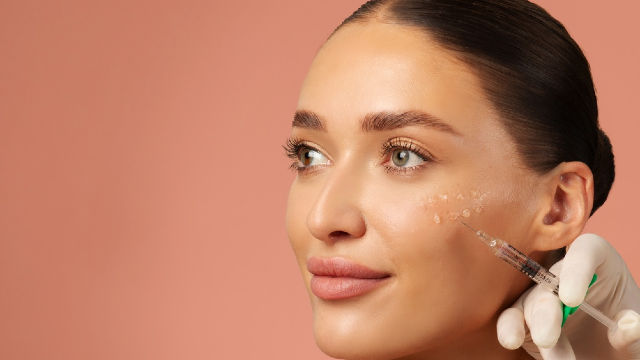
It is an injectable dermal filler containing calcium hydroxylapatite microspheres suspended in a gel carrier — CaHA, in the shorthand. It is used primarily for restoring facial volume and improving the appearance of wrinkles and folds.
Two effects, two clocks
Here is the part worth getting straight.
The gel carrier provides a structural effect immediately. Material is placed, the contour changes, and the change is there when you get up — the ordinary behavior of a filler.
The microspheres do something slower. Depending on the formulation and technique, collagen-stimulating effects may also contribute to a gradual improvement in skin quality over the months that follow.
So one appointment starts two processes that mature at different times. The documented shape is an immediate structural effect, then a collagen effect over months, with that second effect fullest at about three months. Duration overall is commonly discussed as around 12 to 18 months, with one session per cycle and a review at three months.
For a patient who has flown a long way and will not easily return, that combination is genuinely useful: you leave with something visible, and something else continues without you. It is the closest thing in this category to a single-visit treatment that keeps working.
It also creates a specific misreading. Patients sometimes judge the whole treatment on day one, conclude they know what they bought, and never come back to look at it. Others see the day-one result settle slightly as swelling resolves, read that as the treatment fading, and become anxious at exactly the point when the slower half has not started. Knowing there are two clocks is most of the protection against both.
A second way it is used
The clinic notes that Radiesse can also be used in diluted or hyperdiluted formulations for certain skin-quality and collagen-stimulation approaches, depending on the treatment plan.
That is a materially different use of the same product — less about placing structure, more about spreading a collagen stimulus across an area. American interest in hyperdilute biostimulator techniques has grown, and this is the clinic's CaHA product for it.
If that is what you are interested in, say so explicitly. "Radiesse" alone does not specify which of the two uses is on the table, and the results, the placement and the expectations differ between them.
The practical test is simple. Ask whether what is proposed for you is a standard or a diluted preparation, and ask what each would be aiming at in your case. A clinician who distinguishes the two readily is working from a plan. One who treats the question as a technicality has probably decided on a default, which may still be the right choice but is worth knowing about.
Who it suits
Adults seeking correction of age-related facial volume loss, moderate-to-severe facial wrinkles and folds, or selected areas needing structural support. Suitability depends on anatomy, skin condition, medical history and treatment goals.
It is not suitable for people with known hypersensitivity to the product's ingredients, active infection or significant inflammation at the injection site, or certain medical conditions that make injectable treatment inappropriate. Pregnancy, breastfeeding, bleeding disorders, medications affecting clotting and significant allergies all need to be discussed with the treating clinician beforehand.
Potential benefits are improved facial volume, a reduction in the appearance of wrinkles and folds, and improved facial contour, with results varying by treatment area, product placement and individual response.
A treatment typically takes 30 to 60 minutes depending on the area and the amount required. It is generally an outpatient procedure, and most patients need one session, with additional sessions recommended based on goals and clinical assessment.
Why the dual behavior suits a single trip
It is worth spelling out why this product keeps coming up in conversations about treatment abroad, because the reason is structural rather than promotional.
A patient who lives near their clinic can choose freely between fast and slow. They can have something that works immediately, come back in three months, and have something else. Neither choice forecloses the other, because returning is trivial.
A patient who has flown to Jeju does not have that freedom. Every treatment they choose has to justify itself against the cost of getting there, and the two obvious options both have a flaw. Something purely immediate gives a result that will have faded before the next realistic trip. Something purely gradual gives nothing to show for the journey and requires a follow-up that may not happen.
A product that does both from one appointment resolves that tension without requiring a second visit. You leave with a change, and a second process continues at home on its own schedule.
That is a real advantage and it is worth naming honestly, including its limit: it does not make this the right product. Which treatment suits you is decided by what your face needs, not by your flight schedule. What the dual behavior does is make this a serious candidate for a patient whose circumstances would otherwise rule out half the menu — and that is a different and smaller claim than the one marketing usually makes for it.
Risks worth reading slowly
Structural fillers carry a risk profile that skin-quality treatments do not, and it deserves to be stated rather than summarized away.
Common temporary effects can include swelling, redness, tenderness, bruising, itching or firmness at injection sites. Less common but potentially serious complications include infection, nodules, vascular occlusion, skin injury and, rarely, vision-related complications.
Vascular occlusion is the one to understand. It is uncommon, it is the reason injector training and anatomical knowledge matter more for structural products than for anything else in this guide, and it is why "who is injecting, and what is their training" is a fair question to ask directly rather than to infer from a clinic's decor.
The U.S. Food and Drug Administration's consumer page on soft tissue fillers and its list of approved dermal fillers are the right background reading before any structural injectable. The American Academy of Dermatology's filler FAQs cover the patient-facing half of the same ground, and its list of questions to ask before a cosmetic treatment is a reasonable script for the conversation.
Where it sits against the alternatives
The clinic's nearest alternatives to Radiesse are Sculptra, Juvelook and conventional dermal filler treatment, and the useful way to hold that list is by what each is for rather than by what each is made of.
A standard gel product changes the contour on the day and does nothing afterwards. Sculptra and Juvelook reverse that — invisible at first, collagen across months, with Sculptra working deeper and more slowly than Juvelook. Radiesse runs both processes from a single appointment, which is why the clinic treats it as complementary to those two rather than as a substitute for either.
That framing answers most comparison questions on its own, and it does so without requiring you to hold any chemistry in your head — only the shape of each product's timeline. If you want to see the change before you fly home, a stimulator alone will disappoint you. If you want nothing visible to happen while you are away, this is the wrong choice. If you want some of each, this is the product built for that.
One appointment, two review points
Because the two effects mature at different times, the aftercare question is really a scheduling question, and it is the one patients most often leave unasked.
Book the review at three months. That is when the collagen effect is documented as fullest, and it is therefore the moment when what you actually received can be assessed as a whole. A review at two weeks tells you about swelling. A review at three months tells you about the treatment.
For someone who will be back in the United States by then, that review has to be planned rather than assumed. Ask before you leave the clinic how it should happen — what they would want to see, in what form, and how to send it. Then take a standard set of photographs on the day of treatment so that the three-month comparison has a baseline.
Keep your own record too: the product, the amount, the areas treated, the date, and whether a diluted or standard formulation was used. Translated documents are available from the clinic, and MedlinePlus, the U.S. National Library of Medicine's patient service, has a short overview of why a personal health record is worth maintaining. For a product whose effect is still developing three months after you get home — and whose duration runs past a year — that record is what turns "something I had done in Jeju" into information a clinician can act on.
Arrangements of that sort are made in advance, not at the door. Use the contact page to set them up; the about page says who will be doing it.
If you take one thing from this guide, make it the review date. Everything else here is background that a good consultation will cover anyway, but the three-month check is the step that falls off the end of a trip and the one that makes the difference between a treatment you assessed and a treatment you merely had.
The Bottom Line
- Radiesse is a calcium hydroxylapatite filler: the gel carrier gives an immediate structural effect and the microspheres can drive a collagen effect over the following months.
- The collagen half is fullest at about three months, and overall duration is commonly discussed as around 12 to 18 months.
- It is used for age-related volume loss, moderate-to-severe wrinkles and folds, and selected areas needing structural support — and, in diluted form, for skin-quality approaches.
- Treatment takes 30 to 60 minutes; most patients need one session, with more added on assessment.
- Book the review at three months and take baseline photographs on the day — a two-week check tells you about swelling, not about the result.
Frequently Asked Questions
What is Radiesse made of?
Calcium hydroxylapatite microspheres suspended in a gel carrier. The carrier provides the immediate structural effect; the microspheres can contribute a collagen effect over months.
When will I see the result?
Part of it immediately — the structural effect is there when you get up. The collagen effect develops over months and is fullest at about three months.
How long does it last?
Commonly discussed as around 12 to 18 months, with one session per cycle and a review at three months.
What is it used for?
Age-related facial volume loss, moderate-to-severe wrinkles and folds, and selected areas requiring structural support. Diluted or hyperdiluted formulations are used for certain skin-quality and collagen-stimulation approaches.
What are the serious risks?
Uncommon but real: infection, nodules, vascular occlusion, skin injury and, rarely, vision-related complications. They are the reason to ask directly who is injecting and what their training is.
How is it different from Sculptra or Juvelook?
Those two give you nothing on the day and build collagen across months. A standard gel product gives you the change at once and nothing after. Radiesse runs both processes from one appointment, so it sits alongside the others rather than replacing them.
What should I arrange before I leave the clinic?
A three-month review and how it will happen remotely, a baseline set of photographs taken on the day, and a written record of the product, the amount, the areas treated and whether a diluted formulation was used.
This article is for general informational purposes only and does not constitute individualized medical advice. It is not a self-diagnosis tool, and it cannot replace an in-person assessment by a licensed dermatologist who has examined your skin.
More Articles
Continue reading our clinical guides.
Ultherapy PRIME Lifting in Korea: What to Expect
Ultherapy PRIME lifting at Liyan Clinic in Jeju: how micro-focused ultrasound works, who it suits, the honest results timeline, and how US patients plan it.
Learn More

Potenza RF Microneedling: Texture, Pores, and Scars
Potenza RF microneedling at Liyan Clinic in Jeju: how needles plus radiofrequency treat texture and acne scars, how long a course runs, and what to ask.
Learn More

Thermage FLX RF Skin Tightening: A Patient's Guide
Thermage FLX at Liyan Clinic in Jeju: how monopolar radiofrequency tightening works, what the shot count means, the results timeline, and who it suits.
Learn More