Personalized Medical Care & Dedicated International Patient Concierge

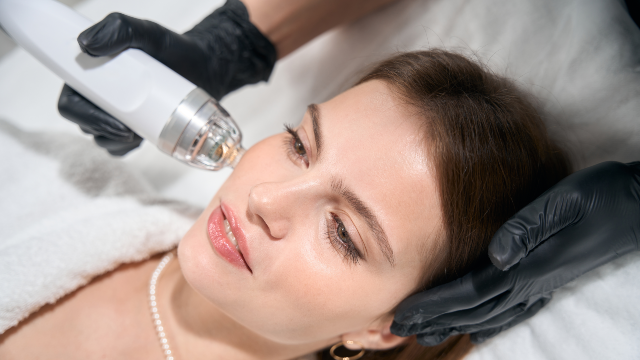
Medical Guide
Potenza RF Microneedling vs Traditional Microneedling
Potenza vs microneedling at Liyan Clinic in Jeju: what adding radiofrequency to a needle changes, what the course commits you to, and how to choose.
Schedule a ConsultationPotenza RF Microneedling vs Traditional Microneedling
Medically reviewed by Dr. Oh Eunhui, Medical Director, Liyan Clinic
The Potenza vs microneedling question usually gets answered as though one were a stronger version of the other. It is not. Both put fine needles into skin, and that shared step is genuinely where the similarity ends — because in one of them the needle is the treatment, and in the other the needle is a delivery route for something else.
Potenza is one of the treatments American patients most often ask Liyan Clinic about, so the distinction is worth getting right before you book either.
What a needle on its own does
Traditional microneedling is a mechanical treatment. Fine needles create controlled channels in the skin, and the skin's own repair response to that controlled injury is the mechanism. Nothing is added and nothing is heated; the injury is the entire intervention.
The American Academy of Dermatology's material on microneedling to fade scars describes what that approach is used for and what a realistic course looks like in the United States, and it is a reasonable baseline for expectations. The US Food and Drug Administration publishes consumer information about microneedling devices themselves, which is worth reading for a separate reason: it sets out that these are regulated devices with defined intended uses, a useful frame when you are comparing offerings that all describe themselves with the same word.
Mechanical treatment has a real advantage, and it is easy to lose in a comparison that is trying to sell you the newer thing. What it does is predictable. The variable is the depth and the pattern, and there is no second energy to get wrong.
What adding radiofrequency changes
Potenza is described as an RF microneedling treatment that combines microneedling with radiofrequency energy, designed to improve overall skin condition and produce smoother, more even-looking texture.
The important word is "combines". The needles still make their channels, but they also deliver radiofrequency energy at depth, so the skin receives a thermal effect at a chosen level in addition to the mechanical one. The platform is fractional, can use monopolar or bipolar radiofrequency and different needle configurations, and provides multiple modes and treatment depths so the treatment can be matched to the individual case.
Three consequences follow, and they are the substance of the comparison.
The treatment has more variables. A needle-only treatment is set by depth and pattern. Add energy and you have also chosen a mode, an amount and a depth at which that energy is released. More control is only an advantage in hands that use it deliberately, which is why "what settings would you use for me, and why" is a fair question rather than an impertinent one.
The target can sit deeper than the needle's mechanical effect alone. Energy released at depth acts where it is released. That is the argument for the combined approach in concerns that are not purely superficial.
It is not a deeper needle. This is the misreading to avoid. The combined treatment is not the mechanical one turned up; it is a different treatment that happens to share an applicator. Expecting it to be "microneedling but more" leads people to compare the two on intensity, which is the wrong axis entirely.
What the course actually commits you to
This is where the decision gets practical, and the numbers here are documented.
A Potenza session runs 40 to 60 minutes of chair time, numbing included. Three or more sessions a month apart is the usual course for this class. Expect the first shift in texture at roughly the three-to-four-week mark. The peak comes later still — reckon two to three months on from your final appointment — and since the effect builds session by session, holding it means returning periodically.
Read that as a schedule rather than as a specification. A course of three monthly sessions is a three-month commitment before the final session, and then a further two to three months before you are looking at the finished result. For someone living near the clinic that is ordinary. For someone flying in, it is the whole decision.
There are three honest ways to handle it and one dishonest one.
You can plan a course you can genuinely complete, which for most visitors means returning or arranging the remainder with a clinician at home. You can ask explicitly what a partial course produces — not whether it is "still worth it", but what specifically you would and would not expect from two sessions of three. Or you can choose a treatment whose result does not depend on a course, and accept that it is answering a slightly different question.
The dishonest option is to start a course you already know you cannot finish and hope it works out. Cumulative means cumulative; the arithmetic does not bend because of a flight schedule.
What each feels like, and what to expect afterwards
Both approaches share the general shape of a needle-based treatment — visible treatment points, some redness, and a short period where skin looks worked on rather than finished.
Where they differ is that the combined treatment adds a thermal component, and thermal effects in skin belong to a different risk conversation than mechanical ones. That is not a reason to avoid it. It is a reason to have the conversation: what recovery should you expect, what would be outside the expected range, and who do you contact if something is.
Numbing is part of the Potenza appointment — the documented chair time includes it — which tells you something about the sensation to expect, and is worth knowing if your previous experience is of a purely mechanical treatment.
For a broader sense of where needle-based work sits among resurfacing options, the Academy of Dermatology's material on laser treatment for scars covers a different mechanism aimed at some of the same concerns, and its microdermabrasion FAQs describe what a purely surface-level mechanical treatment reaches. Reading all three together is the fastest way to stop treating "skin texture" as one category.
Where needle-based work sits among texture treatments
It helps to place both of these against the other things sold for "skin texture", because the category is broad enough to be misleading.
At the shallow end are purely mechanical surface treatments. The Academy of Dermatology's microdermabrasion FAQs describe what that kind of approach reaches and what it does not — useful mainly as a lower bound, since a treatment acting on the surface cannot do what one acting at depth does, and should not be compared with it on results.
In the middle sit needle-only treatments, which act through controlled injury at a selected depth and rely entirely on the skin's repair response.
Then there are the combined and energy-based approaches, of which the radiofrequency-assisted option is one and laser treatments are another. The Academy's material on laser treatment for scars covers a different mechanism aimed at some of the same concerns, and reading it next to the microneedling material is the fastest way to see that "texture" is not one problem.
Where your own concern sits in that order is the thing to establish at consultation. It is also the reason a recommendation that jumps straight to a device name, without first placing your concern, is worth a follow-up question.
The days after, and what to plan for
Both approaches leave visible signs of having been treated, and the honest planning question is how many days you need before you would be comfortable being looked at closely.
A needle-based treatment produces visible treatment points and redness in the immediate aftermath, and skin that looks worked on rather than finished for a short period. Adding a thermal component does not change the shape of that pattern, but it does add a second variable to it, which is why the specific recovery you should expect is a question for the clinician who chose your settings rather than something to read off a general article.
Two practical points follow. If you have an event, count backwards from it generously rather than tightly — a treatment that most people recover from quickly is not a treatment everyone recovers from quickly. And ask what would be outside the expected range, and who to contact if you see it. That second question takes ten seconds to ask and is the one people most regret not having asked.
Choosing, when you live somewhere else
Here is the way to run this decision that keeps you out of the common traps.
Start with the concern rather than the technology. Texture, pores and scarring are not one problem, and the honest recommendation differs between them. Say which one you have, and say how long it has been there.
Then ask the scheduling question before the technical one. How many sessions would you propose; over how long; what would you expect after each; and what would you expect if I completed only part of the course. A clinic that answers those four specifically is giving you the information you need to decide. A clinic that answers them with enthusiasm is not.
Then, and only then, ask about settings and depths — not because you will evaluate the answer technically, but because the shape of the answer tells you whether the plan is yours or generic.
MedlinePlus, the US National Library of Medicine's patient service, recommends bringing written questions to a medical appointment. For this comparison the list is exactly the four above, and it fits on a phone screen.
Send them ahead through the contact page rather than arriving with them; the about page describes the practice that will be answering. A course-based treatment is worth settling in advance, because the first session is the point at which the commitment starts rather than the point at which you decide.
The Bottom Line
- Traditional microneedling is mechanical: fine needles create controlled channels and the skin's repair response is the whole mechanism.
- Potenza combines microneedling with radiofrequency energy delivered at depth, on a fractional platform with monopolar or bipolar modes, varied needle configurations and selectable depths.
- It is not a stronger needle — it is a different treatment with more variables, which is why the settings and the reasoning behind them are worth asking about.
- The course is the commitment: 40 to 60 minutes per session including numbing, three or more sessions at monthly intervals, texture change from three to four weeks, and the fullest effect two to three months after the last session.
- If you cannot complete a course, ask what a partial one produces before you start it rather than after.
Frequently Asked Questions
Is Potenza just stronger microneedling?
No. It combines the mechanical action of microneedling with radiofrequency energy delivered at depth, which makes it a different treatment rather than a more intense version of the same one.
How many sessions will I need?
A course of three or more sessions at monthly intervals is usual for this class of treatment, with results cumulative across the course and maintained with periodic sessions afterwards.
How long is each appointment?
Chair time is 40 to 60 minutes, including numbing time.
When will I see a change?
The first texture change shows at roughly the three-to-four-week point, and the peak arrives later — two to three months on from the course's last appointment.
What if I can only have one session?
Ask the clinic specifically what a single session or a partial course would and would not produce for your concern. Because the effect is cumulative, that answer is the one that should decide whether you start.
What are the settings for?
The platform offers monopolar or bipolar radiofrequency, different needle configurations, multiple modes and selectable depths so treatment can be matched to the individual case. Asking which would be used for you, and why, is reasonable.
Which is better for acne scarring?
That depends on the scarring, and needle-based treatment is only one of the options aimed at it. Describe the scars and their history at consultation rather than choosing the technology first.
Does it hurt?
Numbing is included in the documented appointment time, which is a fair indication of what to expect. Discuss comfort specifically if your previous experience is of a needle-only treatment.
This article is for general informational purposes only and does not constitute individualized medical advice. It is not a self-diagnosis tool, and it cannot replace an in-person assessment by a licensed dermatologist who has examined your skin.
More Articles
Continue reading our clinical guides.
Ultherapy PRIME Lifting in Korea: What to Expect
Ultherapy PRIME lifting at Liyan Clinic in Jeju: how micro-focused ultrasound works, who it suits, the honest results timeline, and how US patients plan it.
Learn More

Potenza RF Microneedling: Texture, Pores, and Scars
Potenza RF microneedling at Liyan Clinic in Jeju: how needles plus radiofrequency treat texture and acne scars, how long a course runs, and what to ask.
Learn More

Thermage FLX RF Skin Tightening: A Patient's Guide
Thermage FLX at Liyan Clinic in Jeju: how monopolar radiofrequency tightening works, what the shot count means, the results timeline, and who it suits.
Learn More