Personalized Medical Care & Dedicated International Patient Concierge

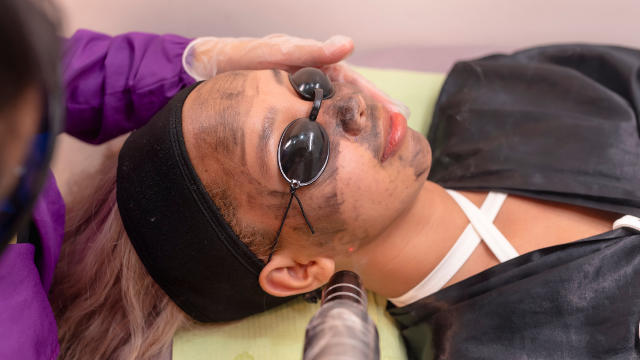
Medical Guide
Pico Toning vs Traditional Laser Toning for Pigmentation
Pico toning vs laser toning at Liyan Clinic in Jeju: what a picosecond pulse does differently to pigment, what a course involves, and why it recurs.
Schedule a ConsultationPico Toning vs Traditional Laser Toning for Pigmentation
Medically reviewed by Dr. Oh Eunhui, Medical Director, Liyan Clinic
The Pico toning vs laser toning comparison comes down to one specification that sounds like a technicality and is not: how long each pulse lasts. Shorten the pulse enough and the laser stops working primarily by heating and starts working primarily by breaking things apart. That change of mechanism is the whole argument, and it is worth understanding before you sit through a course of anything.
Pico Toning is among the treatments Liyan Clinic is best known for in the US market, and it sits in the clinic's laser and light-based group.
What "picosecond" is measuring
The name is a unit of time, not a brand of result.
Pico Toning at this clinic is a picosecond-pulse laser treatment. Laser energy delivered in picosecond pulses breaks pigment by a predominantly photomechanical effect rather than by heating — which is why the same platform is used on pigment, on tattoo ink, and in fractional mode for resurfacing.
Longer pulses deposit their energy over a longer interval, and energy deposited over a longer interval behaves more like heat: it spreads into whatever is nearby. Shorten the pulse far enough and the energy arrives faster than it can spread, so what the target experiences is closer to a mechanical shock than to a burn.
That is the distinction in one paragraph, and everything patients actually care about follows from it.
Why the mechanism matters for pigment specifically
Pigment is a difficult target because the thing you want to affect is sitting in skin you do not want to affect.
A mechanism that works by heating has to heat the pigment without heating its surroundings past what they will tolerate. A mechanism that works mechanically has less of that problem by construction. It is not that heat is bad — it is that in pigment work, the surrounding skin's tolerance is the constraint that decides how aggressive a treatment can be.
This matters most in melasma, which is the concern that brings a large share of patients to pigment lasers in the first place and is also the one most likely to be made worse by an overly aggressive approach. The American Academy of Dermatology's overview of melasma and its treatment guidance are both worth reading before any laser consultation, because they set out how stubborn the condition is and why treatment is generally approached as management rather than as a single fix. Nothing in this article changes that framing, and a clinic that promises otherwise is promising something the condition does not offer.
The clinic is explicit on the same point in its own terms: treatment may help improve the appearance of pigmentation and create a more even-looking complexion, results vary by pigmentation type, skin condition, laser settings and the number of sessions, and complete removal of pigmentation should not be promised.
What this clinic uses it for
The documented uses are broader than "pigmentation", and the breadth is part of why the platform is worth knowing about.
Treatment covers the full face, and also eyebrow and eyeliner tattoo, with body tattoo considered on consultation. Candidates are adults in good general health whose main concern is melasma and mixed pigmentation, freckles and sun spots, tattoo ink, or acne scarring in fractional mode — and who understand that the change is non-surgical and gradual rather than instant, with visible change after each session rather than one transformation.
Patients most often come for freckles, sun-related pigmentation, uneven skin tone and a dull-looking complexion, and the non-surgical nature and relatively limited downtime are part of the appeal.
The settings are not one thing. The specific wavelength, device and parameters depend on the pigmentation type and the treatment objective, and the practitioner assesses skin condition, pigmentation type, skin tone, previous treatments and medications before selecting them. That last point is the one to hold onto when comparing offerings between clinics: two treatments described with the same word can be doing materially different things.
Sessions, and what a course looks like
A session usually takes 15 to 30 minutes, and pigment work in this class normally needs a course of several sessions. No overnight stay is required.
Skin tone may appear gradually more even as treated pigment clears, and multiple sessions may be recommended for persistent pigmentation. Most patients can resume normal activities relatively quickly, although mild redness or sensitivity may remain temporarily, and recovery varies with treatment intensity and individual skin response.
For a visitor, the useful feature of this profile is that a short appointment with limited downtime can fit inside a trip without reorganizing it, and — because visible change follows each session rather than only the last — you are not entirely blind to whether your skin is responding before you leave. What you cannot do inside a single trip is complete a course of several sessions, so the realistic question to raise at consultation is what a partial course achieves and what the sensible way to continue at home would be.
The risks that belong to pigment work
These are not the generic risks of an aesthetic appointment, and they deserve reading slowly.
Temporary redness, warmth, dryness, sensitivity or mild swelling can occur after treatment. Temporary darkening or lightening of pigmentation can occur, and — less commonly — burns or scarring, particularly where treatment is unsuitable or overly aggressive.
Note the phrasing of that last clause, because it is doing real work. The serious complications of pigment lasers are associated with unsuitable or overly aggressive treatment, which makes the assessment the safety step rather than the machine. This is the reason to be suspicious of a consultation that moves quickly to settings, and the reason a clinician who declines to treat on a given day is giving you something valuable.
Preparation matters more here than in most categories. Avoid excessive sun exposure and tanning beforehand, and tell the practitioner about medications, skincare products, recent procedures and any history of abnormal pigmentation. The skin should be in a stable, non-irritated condition at the time of treatment. If you have been in strong sun in the days before an appointment, say so rather than hoping it goes unnoticed.
What the assessment is actually sorting
Underneath the technology comparison there is a clinical question that decides more than the choice of laser, and it is worth knowing that it exists.
Pigmentation is not one thing. The clinic's own framing of the alternatives makes the point directly: which approach is appropriate depends on whether the pigmentation is epidermal, dermal, vascular or mixed. Those are different depths and different causes, and they respond differently to the same energy.
That is why the consultation covers skin condition, pigmentation type, skin tone, previous treatments, medications and treatment goals before any setting is chosen — and why the alternatives that may be considered include other pigment lasers, intense pulsed light, topical treatments, chemical peels, or a combination approach rather than a laser at all.
For a patient, the practical consequence is a single question worth asking early: what type do you think mine is, and what does that imply? An answer that engages with the question tells you the assessment happened. An answer that moves straight to a device tells you something else.
It also reframes the comparison in this article's title. The choice between pulse durations only matters once the target has been identified. If your pigmentation is largely vascular, or mixed in a way that needs more than one approach, the better-specified laser is not automatically the better plan.
Why this is maintenance, not removal
Here is the part that most affects whether you are satisfied a year later.
Longevity depends on the underlying cause and on continued sun exposure, so pigmentation can recur. That is not a caveat attached to one laser; it is the nature of the problem. The pigment you treat is gone; the process that produced it is not, and if it is still running, it will produce more.
Two things follow. First, sun protection after a course is not aftercare advice in the decorative sense — it is the part of the plan that determines how long the result lasts. Second, the honest way to think about a course is as a reset followed by maintenance, rather than as a purchase of a permanent outcome.
The Academy of Dermatology's guidance on getting rid of spots on the skin covers the same ground for a US reader, including the range of approaches available and what each is realistically for. Its material on laser treatment for scars is a useful companion if part of your concern is acne scarring rather than pigment alone, since that is a different target even when it is treated on the same platform.
When you are choosing where to have this done — particularly at a distance, where your usual signals are unavailable — MedlinePlus, the US National Library of Medicine's patient service, sets out a structured way to think about choosing a provider. For pigment work the criterion that matters most is not the equipment list. It is whether the assessment was specific to your skin, and whether anyone told you what the treatment would not do.
Ask that in writing before you book: what type of pigmentation do you think this is, what would you expect after one session and after a course, and what should I do afterwards to keep it. Those go to the contact page, and the about page describes the practice receiving them.
The Bottom Line
- The distinction is pulse duration: picosecond pulses break pigment by a predominantly photomechanical effect rather than by heating, which is why the same platform also handles tattoo ink and fractional resurfacing.
- Settings are chosen per case — the wavelength, device and parameters depend on the pigmentation type and the objective, so two treatments sharing a name are not necessarily the same treatment.
- A session is 15 to 30 minutes with limited downtime, and pigment work in this class normally needs a course of several sessions.
- The serious risks — burns, scarring, temporary darkening or lightening — are associated with unsuitable or overly aggressive treatment, which makes the assessment the safety step.
- Pigmentation can recur, because longevity depends on the underlying cause and on continued sun exposure. Treat a course as a reset plus maintenance, not as removal.
Frequently Asked Questions
What does "picosecond" actually mean here?
It describes the pulse duration. Energy delivered in picosecond pulses breaks pigment by a predominantly photomechanical effect rather than by heating, which is the core distinction from longer-pulse approaches.
What concerns is it used for?
Melasma and mixed pigmentation, freckles and sun spots, tattoo ink, and acne scarring in fractional mode. The clinic treats the full face, plus eyebrow and eyeliner tattoo, with body tattoo considered on consultation.
How long is a session, and how many will I need?
Fifteen to thirty minutes. Pigment work in this class normally needs a course of several sessions, and persistent pigmentation may need more.
Will my pigmentation come back?
It can. Longevity depends on the underlying cause and on continued sun exposure, which is why sun protection afterwards is part of the plan rather than an afterthought.
Can it remove pigmentation completely?
Complete removal should not be promised. Results vary by pigmentation type, skin condition, settings and the number of sessions, and the realistic goal is a more even-looking complexion.
What are the risks?
Temporary redness, warmth, dryness, sensitivity or mild swelling; temporary darkening or lightening of pigmentation; and, less commonly, burns or scarring, particularly where treatment is unsuitable or overly aggressive.
How should I prepare?
Avoid excessive sun exposure and tanning beforehand, and tell the practitioner about medications, skincare products, recent procedures and any history of abnormal pigmentation. Skin should be stable and non-irritated on the day.
Is it worth having on a short trip?
Visible change follows each session, so a single session is not uninformative. A full course is not completable in one visit, so ask what a partial course achieves and how to continue afterwards.
This article is for general informational purposes only and does not constitute individualized medical advice. It is not a self-diagnosis tool, and it cannot replace an in-person assessment by a licensed dermatologist who has examined your skin.
More Articles
Continue reading our clinical guides.
Ultherapy PRIME Lifting in Korea: What to Expect
Ultherapy PRIME lifting at Liyan Clinic in Jeju: how micro-focused ultrasound works, who it suits, the honest results timeline, and how US patients plan it.
Learn More

Potenza RF Microneedling: Texture, Pores, and Scars
Potenza RF microneedling at Liyan Clinic in Jeju: how needles plus radiofrequency treat texture and acne scars, how long a course runs, and what to ask.
Learn More

Thermage FLX RF Skin Tightening: A Patient's Guide
Thermage FLX at Liyan Clinic in Jeju: how monopolar radiofrequency tightening works, what the shot count means, the results timeline, and who it suits.
Learn More